Alibaba Qwen API and Model Studio Review: Models, Features, Pricing, and Setup in 2026
Information current as of September 29, 2026.
Qwen is often seen simply as a family of Chinese models that you can download from Hugging Face or access through a third-party inference provider. But Alibaba also has a full-fledged cloud platform of its own: Alibaba Cloud Model Studio. It provides access to commercial and open-weight Qwen models, image and video models, realtime audio, embeddings, OCR, specialized models, and third-party DeepSeek, Kimi, GLM, and MiniMax models.
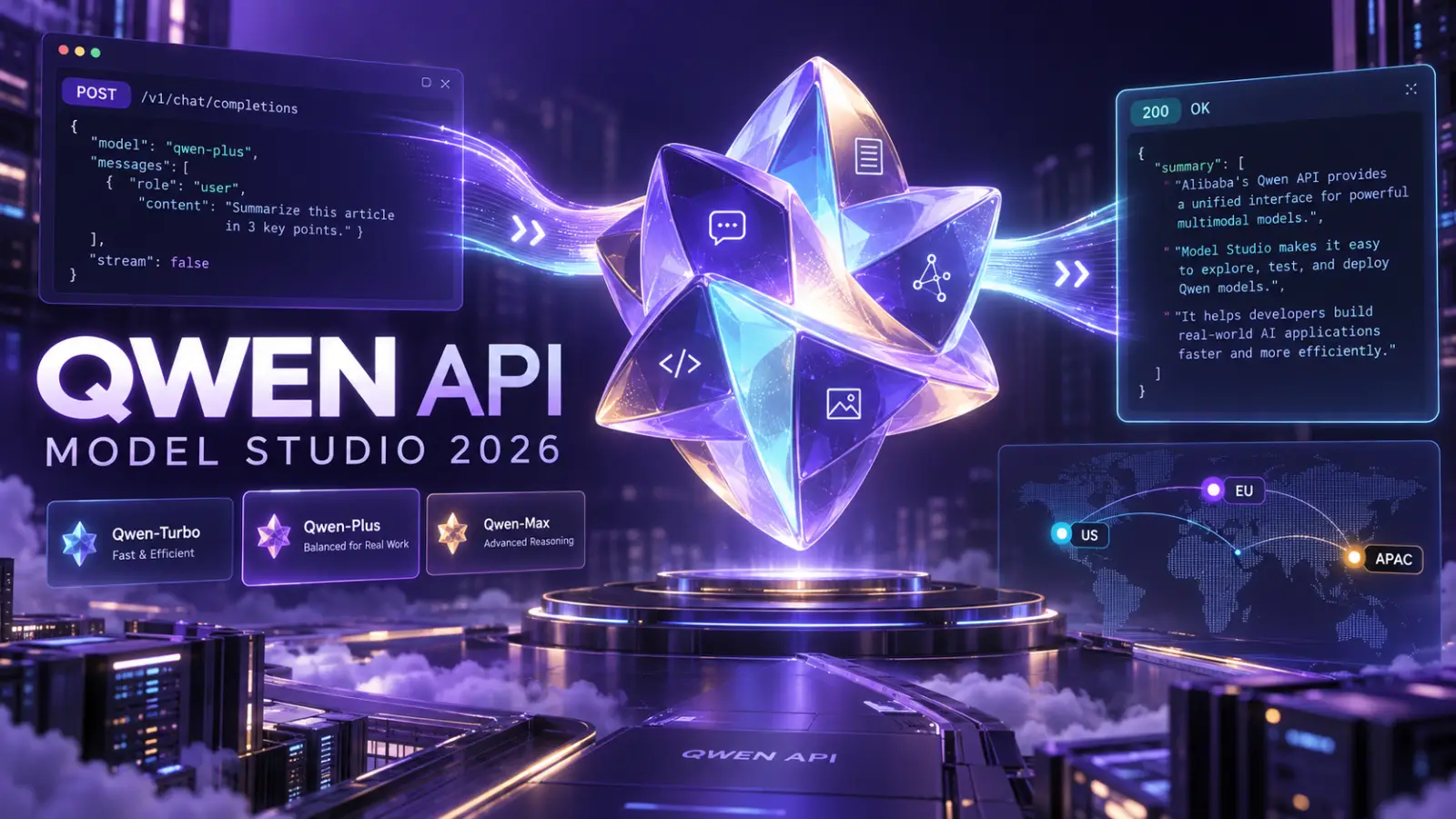
In 2026, Model Studio stands out in particular because it aims to support two of the largest API ecosystems at once. You can call Qwen through OpenAI Chat Completions, the OpenAI Responses API, and the Anthropic Messages API. For capabilities that do not fit those formats, there is Alibaba's native DashScope API.
The current Qwen3.8 Max and Qwen3.8 Flash already offer a million-token context window, work with text, images, and video, and support reasoning, function calling, and Structured Outputs. Flash in the International region costs just $0.15 per million input tokens and $0.47 per million output tokens.
This review explains how Qwen differs from Model Studio, which models are worth considering, how regions and data storage work, what the API costs, how to register and get a key, payment and access considerations across countries, and how to connect to Qwen from PHP.
Qwen and Alibaba Cloud Model Studio are not the same thing
It helps to start by separating two concepts.
Qwen is Alibaba's model family. It includes the large multimodal Qwen3.8 models, Qwen Image, Qwen Omni, Qwen Audio, Qwen ASR, Qwen TTS, Qwen Coder, embedding and reranking models, and many earlier variants. Some are commercial models; others are released with open weights.
Alibaba Cloud Model Studio is the cloud platform that provides API access to these models. In addition to Qwen, it offers third-party DeepSeek, Kimi, GLM, MiniMax, and other models. The platform includes API keys, billing, workspaces, regional endpoints, monitoring, batch inference, context caching, and additional AI tools.
So “Qwen API” usually means calling Qwen through Model Studio, but Model Studio itself covers much more than a single model family.
Which APIs does Model Studio offer?
There are currently four main interfaces for text generation:
- OpenAI-compatible Chat Completions — the simplest option for standard generation and migrating existing OpenAI code;
- OpenAI-compatible Responses API — a more modern interface with stateful conversations and built-in tools;
- Anthropic-compatible Messages API — for apps and tools that already work with the Claude API;
- DashScope API — Alibaba's own interface, with the fullest access to platform-specific capabilities.
This is one of Model Studio's strongest points. If an app already uses the OpenAI SDK, you can often try Qwen by changing the API key, base URL, and model name. Some models can be connected in a similar way through the Anthropic SDK.
Compatibility does not mean that the entire platform is an exact copy of OpenAI or Anthropic. Specialized image, video, realtime audio, and some Model Studio features use their own endpoints and parameters.
Current Qwen3.8 Max and Flash models
For a new general-purpose app in late September 2026, the first two models to consider are:
| Model | Context | Maximum output | International input | International output | Main use case |
|---|---|---|---|---|---|
qwen3.8-max |
1M | 131,072 | $2 / 1M | $6 / 1M | complex agentic, coding, and multimodal tasks |
qwen3.8-flash |
1M | 131,072 | $0.15 / 1M | $0.47 / 1M | high-volume inference, agents, coding, and vision |
Both models accept text, images, and video and return text. They support hybrid thinking, function calling, Structured Outputs, context caching, and access through OpenAI- and Anthropic-compatible APIs.
The prices in the table are for Singapore / International deployment scope. This matters because Model Studio uses regional pricing. For example, under Global scope in Frankfurt, Virginia, Tokyo, and some other regions, the current base price for qwen3.8-max is about $1.65/$4.951, while qwen3.8-flash is $0.113/$0.382 per million input/output tokens.
Qwen3.8 Max
qwen3.8-max is Qwen's current top commercial model for complex, multi-step tasks. It has a million-token context window, a maximum input of about 992K tokens, and output of up to 131,072 tokens.
In thinking mode, the model can use up to 262,144 tokens of chain-of-thought budget. Reasoning can be adjusted with reasoning_effort.
It supports text, image, and video input, function calling, Structured Outputs, hybrid thinking, context caching, web search in supported regions and APIs, the Responses API, and Anthropic Messages compatibility.
In the Singapore International scope, the price is $2 per million regular input tokens and $6 per million output tokens. Implicit cached input costs $0.25 per million; explicit cache reads cost $0.17.
Max is worth evaluating for complex programming, large codebases, document research, visual analysis, and agentic tasks where the less expensive Flash does not deliver a reliable enough result.
Qwen3.8 Flash
qwen3.8-flash is a less expensive model from the same new Qwen generation. The word Flash here does not mean a small model limited to classification: Alibaba positions it for coding assistance, agentic workflows, visual understanding, and long-context work as well.
Its context window is also 1M tokens, and its maximum output is 131,072. The model can analyze images and videos up to two hours long, subject to API limits.
Singapore International pricing:
input:                  $0.15 / 1M
output:                 $0.47 / 1M
implicit cached input:  $0.016 / 1M
explicit cache read:    $0.016 / 1M
For a high volume of requests, the difference from Max is substantial. For a new product, it makes sense to test Flash first, then use Max as a stronger tier or fallback for harder cases.
What does one large request cost?
Consider a hypothetical request with 100K input tokens and 10K output tokens in Singapore International scope, without caching.
| Model | Cost |
|---|---|
| Qwen3.8 Flash | $0.0197 |
| Qwen3.8 Max | $0.26 |
That is a difference of more than ten times.
This does not mean Flash is always cheaper in practice. If a difficult task has to be corrected or resubmitted to Max several times, the actual cost of a successful run may be different. But for extraction, classification, image analysis, bulk generation, and some agentic workloads, the difference is certainly worth testing.
In Global scope, the cost may be even lower. For example, 100K input + 10K output tokens on qwen3.8-flash at the current $0.113/$0.382 rates comes to about $0.0151.
Other Qwen models and open-weight versions
Model Studio contains many more Qwen models than Max and Flash. The current catalog also includes Qwen3.7 Plus, Qwen3.7 Flash, Qwen3.6, Qwen3.5, Qwen Coder, Qwen VL, Qwen Omni, and specialized variants.
For production, it is important to understand the model lifecycle. Aliases such as qwen3.8-max or qwen3.8-flash point to the current version in that line, while a snapshot model ID pins a specific release.
Open-weight Qwen3.8 models are also available, including qwen3.8-2.4t-a95b and qwen3.8-27b. Both have a million-token context window. In Singapore, the first costs $2/$6 per million input/output tokens; the second costs $0.50/$3.
However, “open” does not mean the license is the same for every model. Qwen3.8-27B is published under Apache 2.0, while 2.4T-A95B uses a separate Qwen3.8-Max license with additional conditions for very large commercial products and Model-as-a-Service businesses. Before self-hosting, check the license for the specific repository.
Thinking and reasoning
Qwen3.8 Max and Flash are hybrid-thinking models. Thinking is enabled by default, but its intensity can be changed or turned off completely for simple tasks.
The OpenAI-compatible API uses reasoning_effort. The main levels for Qwen3.8 are:
low
medium
xhigh
xhigh is used by default. For compatibility, some standard OpenAI values are automatically mapped to these levels.
For example:
{
  "model": "qwen3.8-flash",
  "messages": [
    {
      "role": "user",
      "content": "Analyze the application's architecture and find potential failure points."
    }
  ],
  "reasoning_effort": "medium"
}
The higher the reasoning effort, the more tokens the model may spend on analysis. Maximum reasoning is usually unnecessary for simple extraction, so controlling effort can reduce both latency and output-token usage.
Multimodality: images and long videos
Qwen3.8 Max and Flash are natively multimodal. You can send text, images, and video in a single request.
For images, most current visual models support up to 16 million pixels. Higher resolution uses more visual tokens during processing.
Qwen3.8 Max and Flash can process videos up to two hours long and 2 GB in size when using a supported file transfer method. This makes it possible to analyze lectures, meeting recordings, interface demos, long clips, and other sequences without manually splitting them into frames first.
If you also need audio within a video or separate audio input, Qwen Omni is a better fit.
Qwen3.8 Omni
qwen3.8-omni-flash combines several modalities: text, images, video, and audio. The model can analyze sound along with video, which suits tasks where visual context cannot be separated from speech or ambient sounds.
For realtime scenarios, there is qwen3.8-omni-flash-realtime. It accepts text, images, video, and audio and returns text and audio. WebSocket, WebRTC, and AOQ are supported.
The realtime model has a context window of about 196K tokens. Current rates in Singapore International scope:
input audio:            $0.93 / 1M tokens
output audio:           $1.87 / 1M tokens
input text/image/video: $0.23 / 1M tokens
output text:            $0.70 / 1M tokens
This is a foundation for voice assistants and realtime multimodal interfaces, not just a standard chatbot.
OpenAI-compatible Chat Completions
The simplest way to migrate an existing OpenAI app is Chat Completions.
The regional base URL for Singapore looks like this:
https://{WorkspaceId}.ap-southeast-1.maas.aliyuncs.com/compatible-mode/v1
You can then use the standard OpenAI client:
from openai import OpenAI

client = OpenAI(
    api_key="YOUR_MODEL_STUDIO_API_KEY",
    base_url="https://YOUR_WORKSPACE.ap-southeast-1.maas.aliyuncs.com/compatible-mode/v1",
)

response = client.chat.completions.create(
    model="qwen3.8-flash",
    messages=[
        {
            "role": "user",
            "content": "Explain dependency injection."
        }
    ],
)

print(response.choices[0].message.content)
This interface is sufficient for plain text, Structured Outputs, and function calling. If you need stateful sessions and server-side tools, the Responses API is more interesting.
OpenAI-compatible Responses API
Model Studio supports the OpenAI-compatible Responses API and adds its own agentic capabilities to it.
Compared with standard Chat Completions, its main advantages are:
- you can pass either a plain string or a message array;
- you can link the next turn using
previous_response_id; - built-in web search and web extraction are available;
- Code Interpreter is supported;
- text-to-image and image-to-image tools are available for compatible models;
- the server can manage conversation history.
In other words, the architecture is already closer to the OpenAI Responses API than to the older /chat/completions endpoint.
Availability of specific built-in tools depends on the model, region, and deployment scope. Do not assume that every Qwen model ID in Frankfurt or Singapore automatically comes with the same set of tools.
Anthropic-compatible Messages API
Model Studio also supports the Anthropic Messages API.
To migrate a Claude app, change three things:
- API key;
base_url;- model name.
For example, the Singapore base URL looks like this:
https://{WorkspaceId}.ap-southeast-1.maas.aliyuncs.com/apps/anthropic
You can then use /v1/messages.
The compatible interface supports thinking and tool calling. Available models include Qwen3.8 Max, Qwen3.8 Flash, Qwen Coder, and several third-party DeepSeek, Kimi, and GLM models.
This is especially convenient for Claude Code and other apps designed for the Anthropic Messages API.
DashScope API
DashScope is Alibaba Cloud's own API. Historically, it was the main way to call Qwen, and it still provides the fullest set of Model Studio-specific parameters.
If a task fits the standard OpenAI or Anthropic schema, the compatibility layer is usually simpler. DashScope makes sense when you need a feature unavailable through a compatible endpoint or a specialized model with its own API.
Official DashScope SDKs are available at least for Python and Java. For OpenAI-compatible calls, Alibaba also documents the OpenAI SDK for Python, Node.js, Java, and Go.
Function calling
Qwen3.8 Max and Flash support function calling.
The app describes a function and its JSON Schema. The model decides when to call it and returns structured arguments. The backend performs the actual action.
For example, you could give the model findCustomer, getOrder, and createSupportTicket functions. A user says, “Check order 54821 and create a support ticket if it is delayed.” The model chooses the steps, but it does not get direct access to the database.
As with other LLM APIs, function calling does not replace backend authorization. The app must separately validate the user, parameters, financial limits, and whether the requested data change is allowed.
Structured Outputs
Qwen3.8 supports Structured Outputs. You can specify the expected JSON Schema instead of trying to extract data from arbitrary text.
Typical use cases include:
- parsing emails and documents;
- classifying requests;
- extracting data from images;
- preparing DTOs;
- turning user text into parameters for a backend function;
- agentic workflows where the next step expects a specific structure.
This is especially useful for visual inputs: for example, you can send a product photo and receive valid JSON with its name, brand, attributes, and other fields.
Web Search
Model Studio includes built-in web search. In the Responses API, it is connected as a tool:
{
  "model": "qwen3.8-max",
  "input": "Find current information about the latest PHP version.",
  "tools": [
    {
      "type": "web_search"
    }
  ]
}
The Responses API also offers web_extractor, which can extract content from found or explicitly specified pages.
This reduces the need to connect a separate search API and collect snippets manually. However, both the model and the region must support the specific tool.
For production, account for tool billing separately: the final cost of an agentic request may include calls to search infrastructure in addition to the main model's tokens.
Code Interpreter
The Responses API supports a built-in Code Interpreter for models and regions where it is available.
The model can write and run code, use the result of a calculation, and continue its analysis. This is useful for math problems, CSV files, statistics, reports, and other scenarios where actual program execution is more reliable than text-only reasoning.
In an agent, Code Interpreter can be combined with web search and user-defined functions.
Context Cache
Model Studio has two ways to cache a repeated prompt prefix.
Implicit cache works automatically. The system tries to identify a matching prompt prefix; no separate cache object is required, but a hit is not guaranteed.
Explicit cache is created by the developer. It requires a separate cache record, but provides a more predictable hit.
For most models, the general pricing is roughly as follows: creating an explicit cache costs about 125% of regular input, reading it costs about 10%, and an implicit cache hit costs about 20%. Qwen3.8 has its own rates, however.
For qwen3.8-flash in Singapore:
regular input:          $0.15 / 1M
implicit cache:         $0.016 / 1M
explicit cache create:  $0.20 / 1M
explicit cache read:    $0.016 / 1M
For qwen3.8-max:
regular input:          $2 / 1M
implicit cache:         $0.25 / 1M
explicit cache create:  $2.50 / 1M
explicit cache read:    $0.17 / 1M
With a long system prompt, a large tool schema, or repeated work on the same document, caching can materially change unit economics.
Batch API
Model Studio supports an asynchronous Batch API for some models and regions.
For supported text models, Batch typically costs 50% of realtime inference. Requests are submitted in a JSONL file and processed in a background queue. Once they finish, you can download the results and a separate file with errors.
Batch works well for bulk classification, description generation, data labeling, catalog processing, evaluations, and background analytics.
Support depends on the model ID and region. Before estimating savings, check the current model rather than assuming every Qwen model automatically supports Batch at half price.
Qwen Image 3.0
Model Studio has a separate family for image generation and editing.
The current recommendation is qwen-image-3.0-pro. It is especially aimed at complex layouts and accurate text rendering: menus, newspapers, interfaces, infographics, and other images where the model needs to place text precisely rather than simply draw a scene.
There are two main options:
qwen-image-3.0-pro— highest quality;qwen-image-3.0— faster and less expensive.
Both support generation and editing, up to three input images, and up to six output variants.
Singapore International pricing:
| Model | 1K output | 2K output | Input image |
|---|---|---|---|
| Qwen Image 3.0 Pro | $0.04 | $0.075 | $0.003 |
| Qwen Image 3.0 | $0.03 | $0.03 | $0.003 |
For higher resolutions and complex character-consistent generation, Model Studio also offers the Wan Image family.
Wan for video generation
Alibaba is developing the separate Wan family for video.
The current Wan 3.0 supports text-to-video, image-to-video, reference-based generation, editing, and multimodal reference materials. The model generates dialogue, music, and sound effects along with video.
The base Wan 3.0 price in Singapore is:
480p:   $0.05 / second
720p:   $0.10 / second
1080p:  $0.20 / second
Depending on the selected mode and model version, videos can be up to 30 seconds long.
Model Studio is therefore no longer just a Qwen LLM API. One billing account and infrastructure stack can cover text, images, video, and audio.
Speech-to-Text
Qwen ASR is available for speech recognition.
In Singapore, qwen3-asr-flash costs:
$0.000035 / second
That is about $0.0021 per minute or $0.126 per hour of audio.
Realtime transcription is available through qwen3-asr-flash-realtime at $0.000090 per second, or about $0.0054 per minute.
New Singapore accounts also receive a limited free quota for several audio models.
Text-to-Speech
Model Studio offers several generations of Qwen TTS and CosyVoice.
For example, the current qwen-audio-3.0-tts-flash in Singapore costs:
$0.15 / 10,000 characters
qwen-audio-3.0-tts-plus costs $0.20 per 10,000 characters.
There are separate models for realtime synthesis, voice design, and voice cloning. The platform's speech capabilities now go well beyond simply “turning text into an MP3.”
Embeddings and reranking
Alibaba offers separate embedding and reranking models for building your own RAG system.
For regular text, the recommended option is text-embedding-v4. In Singapore, it costs:
$0.07 / 1M input tokens
Embedding size can be set from 64 to 2,048 dimensions.
For multimodal retrieval, models can map text, images, and video into a shared semantic space. For final reranking, qwen3-rerank supports more than 100 languages and up to 500 documents per request.
Model Studio therefore lets you build RAG with your own vector database or use higher-level platform components.
OCR and translation
The catalog also includes specialized models.
For OCR, qwen-vl-ocr is available in International scope and can extract text and visual information from documents and images.
For translation, there is Qwen MT: qwen-mt-plus, qwen-mt-flash, and qwen-mt-lite. For example, in Singapore, qwen-mt-lite costs $0.12 per million input tokens and $0.36 per million output tokens.
For a narrow, high-volume task, a specialized model may be more economical than using Qwen3.8 Max simply because it is the flagship.
Model Studio also offers third-party models
Alibaba Cloud Model Studio is not limited to Qwen.
Depending on the region, the same platform also offers DeepSeek, Kimi, GLM, MiniMax, and other models from Model Plaza.
For an application, this turns Model Studio into a small multi-model gateway. You can keep one Alibaba Cloud account and infrastructure while choosing different models for different jobs.
However, third-party model pricing, features, and availability depend on the region. Not every model has the same built-in tools as Qwen.
Agents and Workflows
Model Studio has a no-code/low-code layer for building Agent and Workflow applications. An Agent plans its own actions and uses tools or a knowledge base, while a Workflow defines a more deterministic chain of steps.
There is an important limitation for new international users: the old Application Development tab in Singapore is a preview feature, and access is limited to accounts that created such applications before April 21, 2025.
For a new production project, do not design around access to the legacy visual Agent Builder for every new Singapore account. A more portable modern approach is the Responses API, tool calling, and your own orchestration, or other current Model Studio components.
Coding and integration with Claude Code/Codex
Qwen3.8 Flash is explicitly positioned as compatible with the OpenAI and Anthropic API protocols and suitable for Claude Code and Codex.
This makes it possible to use Model Studio as an inference backend for a coding-agent tool without changing the user's workflow.
Model Studio also has a separate Coding Plan with a fixed monthly fee. It is a distinct product with its own API key and list of allowed models. Do not assume that every model from regular pay-as-you-go Model Studio is available in the Coding Plan.
If you specifically need Qwen3.8, check the current list of plan models before purchasing a subscription.
Regions are one of Model Studio's most important features
Alibaba Cloud Model Studio is available at least in:
- China (Beijing);
- Singapore;
- Germany (Frankfurt);
- Japan (Tokyo);
- China (Hong Kong);
- US (Virginia).
The region determines the endpoint, API key, list of available models, static data location, and some platform features.
A Singapore key cannot be used with the Frankfurt endpoint. You create a separate API key for each region.
Alibaba currently recommends a workspace-dedicated endpoint, for example:
Singapore:
https://{WorkspaceId}.ap-southeast-1.maas.aliyuncs.com

Germany:
https://{WorkspaceId}.eu-central-1.maas.aliyuncs.com

US:
https://{WorkspaceId}.us-east-1.maas.aliyuncs.com
Older shared DashScope domains are not yet available in every region and are no longer the preferred option for new production integrations.
Region and deployment scope are different
This is an important detail that is easy to miss.
Region determines the entry point and where static data is stored.
Service deployment scope determines where Alibaba may run the actual model inference.
For example, Frankfurt supports both Global and EU scope. If you choose Global, static data stays in Frankfurt, but computing may be scheduled in a global inference pool. To restrict processing to the EU, you need a model and deployment scope that support EU.
A similar approach is used for the US scope in Virginia.
So using a Frankfurt endpoint alone does not guarantee that all inference processing stays inside the EU. Before going to production, check the deployment scope for the specific model.
Registering with Alibaba Cloud
For international Model Studio access, use Alibaba Cloud International:
https://www.alibabacloud.com
Registration has several steps.
First, create an account and provide an email address, account type, and Country/Region. Then add security, mobile, and billing information to use paid cloud services fully.
Choose Country/Region carefully: it determines the billing currency and taxes and cannot be changed after registration. If you selected the wrong country, Alibaba recommends creating a new account.
Your mobile number must match the selected Country/Region. The international site is intended for users and organizations outside mainland China.
Purchasing Mainland China resources and some enterprise features requires additional identity verification. For ordinary Model Studio use in an international region, a correctly completed international account and billing setup are often sufficient.
Activating Model Studio and getting an API key
After registering an Alibaba Cloud account:
- Open Model Studio.
- Select the required region, such as Singapore.
- Activate Model Studio and Large Model Inference.
- Accept the service agreement.
- Create a Workspace if the selected region uses the workspace model.
- Open the API Key page.
- Create an API key specifically for that region.
- Copy the Workspace ID and regional endpoint.
An API key is not tied to a single model. One pay-as-you-go key can call models available in its region/workspace.
Token Plan and Coding Plan use separate keys in the sk-sp- format, so do not confuse them with a regular pay-as-you-go API key.
Free quota
Model Studio offers free quota for many models, but at present it mostly applies to Singapore / International scope.
For example, Qwen3.8 Max and Flash each include one million free tokens. The quota usually lasts 90 days from Model Studio activation, model release, or approval, depending on the specific rule.
The same free quota may not be available in other regions.
This makes Singapore the easiest region for an international user to run an initial test, though it may not be the best choice for production requirements around data location.
Payment
Alibaba Cloud Model Studio supports pay-as-you-go and separate subscription mechanisms.
Payment methods depend on the account's Country/Region and contracting entity. Alibaba's international documentation lists bank cards, PayPal/Alipay, and, in some corporate cases, bank transfer.
The current Payment FAQ separately states that standard card enrollment supports international Visa, Mastercard, American Express, and JCB. Prepaid, gift, virtual, and UnionPay-only cards are not supported in this flow.
A small temporary authorization may also be used to verify a payment method during registration.
Businesses can use billing history, invoices, tax information, and other standard Alibaba Cloud Expenses and Costs tools.
Can people in Russia use it?
In the published Alibaba Cloud and Model Studio documentation, I did not find a separate rule that explicitly bars Model Studio registration solely because a user is located in Russia. At the same time, Alibaba Cloud requires compliance with applicable export controls and economic sanctions, including restrictions imposed by the UN, China, the EU, the US, Singapore, and other applicable jurisdictions.
Practical access depends on several independent factors:
- whether the required country can be selected when registering an international account;
- whether phone verification works;
- whether Alibaba accepts the available payment method;
- whether the individual or company is subject to applicable sanctions.
Alibaba Cloud does not provide a separate guarantee that cards issued by Russian banks will be accepted. Its payment documentation only requires a supported international card and successful verification by the issuing bank. A project in Russia should therefore check billing in advance, before Model Studio becomes a critical production dependency.
If direct payment is inconvenient, Qwen can also be used through third-party inference providers or by deploying an open-weight model yourself. That is a different backend: pricing, data location, tools, and available model versions may differ from Alibaba Cloud Model Studio.
Security and use of data for training
Alibaba Cloud states directly in its official FAQ that Model Studio does not use customer business data to train models without explicit consent.
Data sent to the platform is encrypted, and the documentation specifies AES-256 for data within the platform.
This is a meaningful distinction from some consumer AI services: an API call to Model Studio does not mean business data is automatically used for later Qwen training.
However, data privacy is not determined by training policy alone. You also need to consider the selected region, deployment scope, external tools, and third-party models. Global inference scope, for example, differs from a geographically restricted EU scope.
Workspaces and project isolation
Model Studio uses Workspaces to separate resources, permissions, and business data.
You can grant RAM users different workspace permissions so that teams and projects do not automatically have access to each other's data.
For production, this is more convenient than using one shared API key across every environment. It makes more sense to separate development, staging, production, and different business units at the workspace/credential level.
API in PHP
There is no official DashScope SDK for PHP, but that is not a problem: an OpenAI-compatible API is ordinary HTTP.
Example for Singapore:
<?php

$apiKey = $_ENV['DASHSCOPE_API_KEY'];
$workspaceId = $_ENV['MODEL_STUDIO_WORKSPACE_ID'];

$url = sprintf(
    'https://%s.ap-southeast-1.maas.aliyuncs.com/compatible-mode/v1/chat/completions',
    $workspaceId
);

$payload = [
    'model' => 'qwen3.8-flash',
    'messages' => [
        [
            'role' => 'user',
            'content' => 'Briefly explain dependency injection.',
        ],
    ],
];

$ch = curl_init($url);

curl_setopt_array($ch, [
    CURLOPT_POST => true,
    CURLOPT_RETURNTRANSFER => true,
    CURLOPT_HTTPHEADER => [
        'Authorization: Bearer ' . $apiKey,
        'Content-Type: application/json',
    ],
    CURLOPT_POSTFIELDS => json_encode(
        $payload,
        JSON_UNESCAPED_UNICODE
    ),
]);

$response = curl_exec($ch);

if ($response === false) {
    throw new RuntimeException(curl_error($ch));
}

$data = json_decode(
    $response,
    true,
    flags: JSON_THROW_ON_ERROR
);

echo $data['choices'][0]['message']['content'] ?? '';
In Laravel, the HTTP Client is more convenient:
$url = sprintf(
    'https://%s.ap-southeast-1.maas.aliyuncs.com/compatible-mode/v1/chat/completions',
    config('services.model_studio.workspace_id')
);

$response = Http::withToken(config('services.model_studio.key'))
    ->post($url, [
        'model' => 'qwen3.8-flash',
        'messages' => [
            [
                'role' => 'user',
                'content' => 'Briefly explain dependency injection.',
            ],
        ],
    ]);

$text = $response->throw()->json('choices.0.message.content');
Store the API key and Workspace ID in .env, and have application code read them through configuration. Never expose the key directly in the frontend.
Rate limits and Provisioned Throughput
Each model has its own RPM/TPM limits. Standard pay-as-you-go is usually enough for a small application.
For a predictable high load, Model Studio also offers Provisioned Throughput Units (PTU). Unlike standard pay-as-you-go, where you pay for tokens actually used from shared capacity, PTU reserves a set amount of throughput.
This is useful for large production workloads with steady traffic and SLA requirements. For a small SaaS, PTU is usually excessive; pay-as-you-go is simpler.
Why regional pricing may differ
There is no single global price for the Qwen API on Model Studio.
For example, qwen3.8-max:
Singapore / International:  $2 / $6
Global in some regions:     $1.65 / $4.951
qwen3.8-flash:
Singapore / International:  $0.15 / $0.47
Global in some regions:     $0.113 / $0.382
This is because Alibaba separates region, deployment scope, and inference resource pools.
So when comparing Qwen with OpenAI or Claude, copying one line from the pricing table is not enough. You need to determine which region the project will use and which deployment scope it requires.
What makes Model Studio stand out
The platform's main advantage is not one specific model.
First, Qwen3.8 combines a very large context window, multimodality, reasoning, and low-cost Flash.
Second, Model Studio offers three convenient API paths: OpenAI Chat/Responses, Anthropic Messages, and native DashScope.
Third, the platform covers much more than LLMs: Qwen Image, Wan Video, Qwen Omni, ASR, TTS, embeddings, reranking, OCR, and translation are available within one Alibaba Cloud account.
Fourth, some Qwen models can be self-hosted. This reduces long-term dependence on a single cloud API, though the license for each open-weight model must be checked separately.
Finally, Alibaba Cloud provides a fairly detailed regional deployment model. For international business, this is more useful than a generic promise that “data is in the cloud,” though region and service scope must be selected carefully.
What are the limitations?
Model Studio's breadth also makes the platform more complicated than a single-endpoint API.
There are many regions, each with its own API keys, endpoints, model list, and pricing. A model available in Singapore may be missing from the EU scope in Frankfurt.
Some features work only through DashScope, others through OpenAI Responses, and some use a separate realtime protocol. “OpenAI-compatible” does not mean the entire Model Studio can be replaced with one OpenAI SDK.
The model lifecycle is also fast: Alibaba regularly releases snapshots, moves older models to legacy status, and changes recommendations.
Finally, older no-code Agent/Workflow components have serious availability limits for new Singapore accounts, so do not build a new international product architecture around them without checking first.
Which model should you choose?
For most new projects, it makes sense to start with Qwen3.8 Flash. With a million-token context, multimodal input, and a price of $0.15/$0.47 in International scope, it is inexpensive enough to use as the primary backend.
Add Qwen3.8 Max for difficult requests where evaluations show a clear advantage. Using Max for simple classification or extraction is hard to justify when Flash costs more than ten times less on a typical large request.
For realtime audio/video, use Qwen3.8 Omni Flash Realtime.
For images, use Qwen Image 3.0 or 3.0 Pro.
For video, use Wan.
For transcription, TTS, embeddings, reranking, and translation, choose a specialized model instead of the general-purpose Max.
If self-hosting matters, look separately at open-weight Qwen3.8 and check the license of the specific repository.
Conclusion
In 2026, Alibaba Qwen API is no longer just an inexpensive Chinese alternative to GPT. Qwen3.8 offers a million-token multimodal context window, adjustable reasoning, function calling, and Structured Outputs, while Model Studio adds the Responses API, web search, Code Interpreter, image/video/audio models, embeddings, OCR, and a multi-model catalog.
API compatibility is particularly useful. You can connect the same Qwen through OpenAI Chat Completions, the Responses API, or Anthropic Messages, and switch to native DashScope when needed. For a product that does not want to be tightly tied to one client protocol, this is a practical advantage.
But Model Studio requires more attention to infrastructure than a simple single-endpoint API. Region, deployment scope, API key, model availability, and pricing are connected. Choosing a Frankfurt endpoint does not guarantee EU-only inference without the appropriate service scope, and a Singapore key does not work with Virginia.
A practical starting point for an international project looks like this: Singapore for initial testing and free quota, Qwen3.8 Flash as the base model, Max as an escalation tier, the OpenAI-compatible API for a quick integration, and a separate check of the required region before production.
With the option to use open-weight Qwen outside Alibaba Cloud, Model Studio is interesting not only for its low cost but also because it gives a product several paths forward: from an inexpensive managed API to a multi-model cloud platform or your own inference deployment.
Official sources
- Alibaba Cloud Model Studio: https://www.alibabacloud.com/help/en/model-studio/what-is-model-studio
- Models: https://www.alibabacloud.com/help/en/model-studio/models
- Text generation models: https://www.alibabacloud.com/help/en/model-studio/text-generation-model
- Model pricing: https://www.alibabacloud.com/help/en/model-studio/model-pricing
- Qwen3.8 Max: https://www.alibabacloud.com/help/en/model-studio/qwen3-8-max
- Qwen3.8 Flash: https://www.alibabacloud.com/help/en/model-studio/qwen3-8-flash
- First Qwen API call: https://www.alibabacloud.com/help/en/model-studio/first-api-call-to-qwen
- OpenAI-compatible Chat: https://www.alibabacloud.com/help/en/model-studio/compatibility-of-openai-with-dashscope
- OpenAI-compatible Responses: https://www.alibabacloud.com/help/en/model-studio/compatibility-with-openai-responses-api
- Anthropic-compatible Messages: https://www.alibabacloud.com/help/en/model-studio/anthropic-api-messages
- Regions and endpoints: https://www.alibabacloud.com/help/en/model-studio/regions
- Context Cache: https://www.alibabacloud.com/help/en/model-studio/context-cache
- Batch inference: https://www.alibabacloud.com/help/en/model-studio/batch-inference
- Web Search: https://www.alibabacloud.com/help/en/model-studio/web-search
- Image generation: https://www.alibabacloud.com/help/en/model-studio/image-model
- Qwen Image API: https://www.alibabacloud.com/help/en/model-studio/qwen-image-api
- Video generation: https://www.alibabacloud.com/help/en/model-studio/use-video-generation
- Wan 3.0: https://www.alibabacloud.com/help/en/model-studio/wan3-video-generation-guide
- Qwen Omni: https://www.alibabacloud.com/help/en/model-studio/qwen-omni
- Embeddings and reranking: https://www.alibabacloud.com/help/en/model-studio/embedding-rerank-model
- API key: https://www.alibabacloud.com/help/en/model-studio/get-api-key
- Activate Model Studio: https://www.alibabacloud.com/help/en/model-studio/activate-alibaba-cloud-model-studio
- Alibaba Cloud registration: https://www.alibabacloud.com/help/en/account/step-1-register-an-alibaba-cloud-account
- Payment methods: https://www.alibabacloud.com/help/en/user-center/instruction-of-payment-management/
- Payment FAQ: https://www.alibabacloud.com/help/en/user-center/support/payment-faq
- Model Studio FAQ and data policy: https://www.alibabacloud.com/help/en/model-studio/faq-about-alibaba-cloud-model-studio
Our projects
- Anilau
Web development and digital product launch. - Botmarketing
Telegram bots, mini apps, storefronts and CRM for small businesses. - vietnam.anilau.com
Listings, local services and practical guides to Vietnam. - bali.anilau.com
A marketplace for goods and services in Bali. - ceylon.anilau.com
Listings, services and practical information about Sri Lanka. - mauricetop.anilau.com
A platform for listings and information about life in Mauritius. - funlab
A platform for creating and playing AI-generated games. - aura
An AI mood diary and creative space. - drained
A Telegram Mini App for daily fatigue check-ins and recovery. - vietinfodesk
Practical guides, services and help for life in Vietnam. - frau
A cozy Nha Trang cafe profile featuring waffles, breakfast and drinks.
We work in partnership with creative agency Deep.