DeepSeek API Review: Models, Features, Pricing, Registration, and Access from Russia in 2026
Information current as of September 29, 2026.
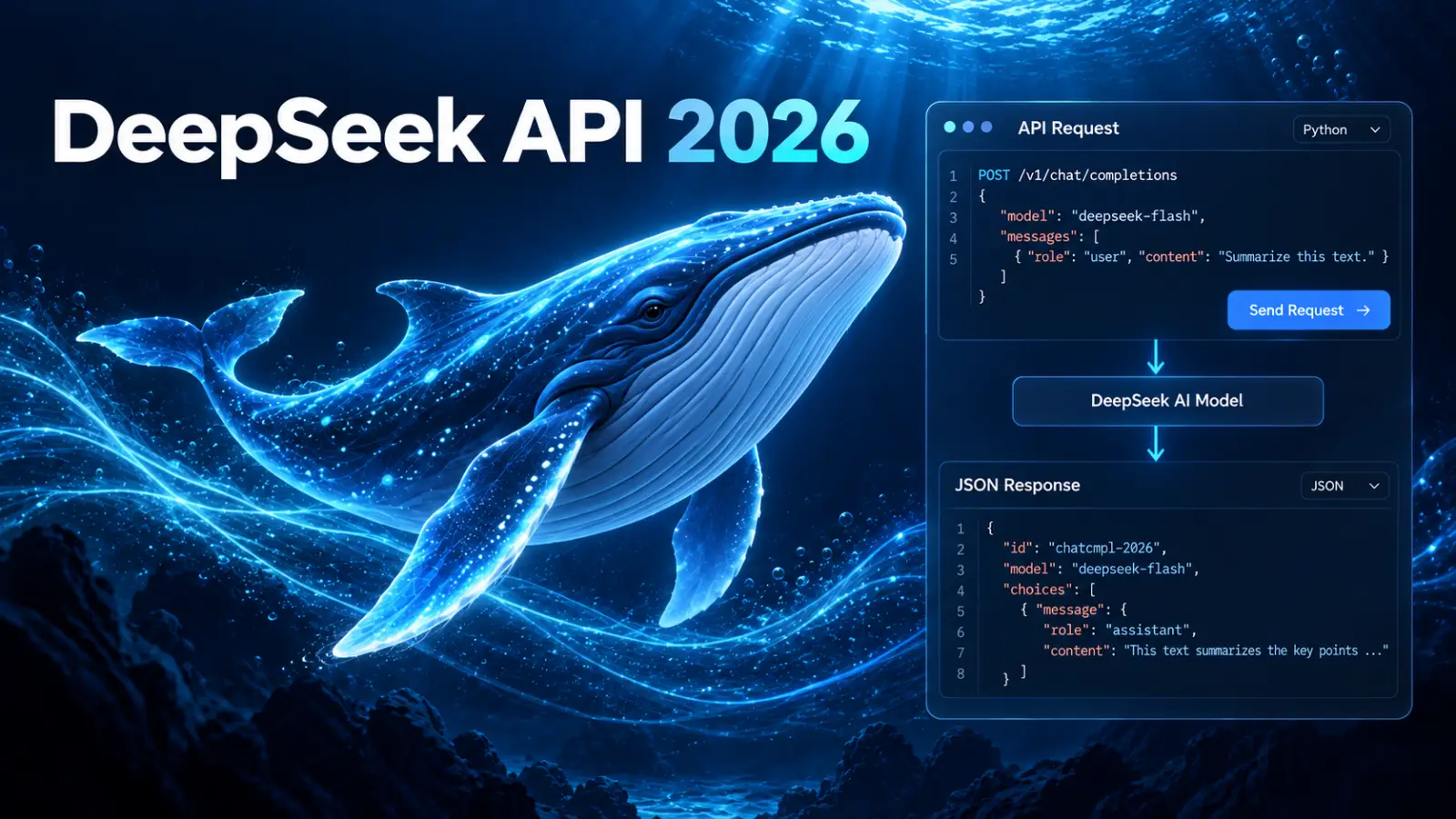
DeepSeek is interesting not only as one of the least expensive major AI APIs. In 2026, it is a full developer platform with a 1M-token context window, reasoning, vision, tool calling, Structured Outputs, compatibility with the OpenAI Responses API and Anthropic API, automatic context caching, and official integration with Codex and Claude Code.
At the same time, DeepSeek has characteristics that developers outside China should pay particular attention to. The service belongs to the Chinese company Hangzhou DeepSeek Artificial Intelligence Co., Ltd.; data is processed and stored in China; its payment infrastructure differs substantially from OpenAI's or Anthropic's; and the availability of some features may depend on jurisdiction. For users in Russia, the main practical problem right now is not registration or the API itself, but topping up the official balance.
This article looks at current DeepSeek models, pricing, the Responses API, reasoning, vision and tool calling. It also walks through the full process from registration to payment and reviews the restrictions that apply to users in different countries and, specifically, in Russia.
What is the DeepSeek API?
The DeepSeek API is DeepSeek's own cloud API for connecting its models to websites, applications, agents, IDEs, and other systems. The main address is:
https://api.deepseek.com
Authentication uses a regular Bearer API key. As of late September 2026, the main recommended model ID is deepseek-flash, which corresponds to DeepSeek-V4.1-Flash.
The platform supports several familiar developer formats:
- OpenAI Chat Completions;
- OpenAI Responses API;
- Anthropic Messages API;
- its own beta features such as FIM Completion;
- Files API for images.
This makes DeepSeek one of the easiest third-party APIs to connect to existing AI infrastructure. A project built on the OpenAI SDK or Anthropic SDK can often be tested with DeepSeek first, without a full rewrite of the client layer.
Current DeepSeek models
At the time this article was prepared, the official API effectively has two main models:
| Model ID | Actual model | Context | Maximum output | Vision | Main use case |
|---|---|---|---|---|---|
deepseek-flash |
DeepSeek-V4.1-Flash | 1M | up to 384K | Yes | Main general-purpose option |
deepseek-v4-pro |
DeepSeek-V4-Pro-0813 | 1M | up to 384K | No | More expensive Pro option |
Both models support thinking and non-thinking modes, JSON Output, tool calls, the Responses API, and the Anthropic-compatible API.
There is an unusual situation with V4 Pro. After releasing V4.1 Flash, DeepSeek initially announced a gradual retirement of V4 Pro because Flash was faster and less expensive. The company then updated its documentation and said that, at users' request, it would continue providing V4 Pro after September 14, 2026. So it is better to rely on the current Models & Pricing page rather than the original release announcement.
DeepSeek-V4.1-Flash
DeepSeek-V4.1-Flash was released on September 10, 2026 and is now the platform's primary model. The API uses the short ID:
deepseek-flash
The previous deepseek-v4-flash and deepseek-v4-flash-vision-exp have already been retired. Their old names are still accepted for compatibility, but requests are actually served by V4.1 Flash.
The model has a 1M-token context window and maximum output of up to 384K tokens. It supports regular text, reasoning, images, JSON, function calling, and the OpenAI Responses API.
V4.1 Flash is especially notable for its price: during off-peak hours, one million input tokens without a cache hit costs $0.15, and one million output tokens costs $0.60. During peak hours, the price doubles.
DeepSeek V4 Pro
deepseek-v4-pro corresponds to V4-Pro-0813. It also has a 1M-token context window and output up to 384K tokens, but does not support vision.
The model is noticeably more expensive than Flash: off-peak, one million input tokens without a cache hit costs $0.66 and output costs $1.98. During peak hours, the respective prices are $1.32 and $3.96.
After the arrival of V4.1 Flash, choosing Pro is no longer automatic even for complex tasks. DeepSeek itself said that, on a number of internal and external tests, the new Flash outperformed V4 Pro in speed, cost, and overall efficiency at the same time. So for a new project, it is more sensible to test deepseek-flash first and add Pro only where your own evaluations show a real difference.
DeepSeek API pricing
DeepSeek uses an unusual pricing scheme for a major AI API: the price depends on the time of day.
DeepSeek-V4.1-Flash
| Token type | Off-peak | Peak |
|---|---|---|
| Input, cache hit | $0.003 / 1M | $0.006 / 1M |
| Input, cache miss | $0.15 / 1M | $0.30 / 1M |
| Output | $0.60 / 1M | $1.20 / 1M |
DeepSeek V4 Pro
| Token type | Off-peak | Peak |
|---|---|---|
| Input, cache hit | $0.022 / 1M | $0.044 / 1M |
| Input, cache miss | $0.66 / 1M | $1.32 / 1M |
| Output | $1.98 / 1M | $3.96 / 1M |
Peak hours apply Monday through Friday:
01:00–04:00 UTC
06:00–10:00 UTC
All other times are considered off-peak and cost half as much.
For background processing, this provides a simple way to save: tasks that do not need a real-time response can be scheduled for off-peak hours.
What a real request costs
Consider a hypothetical request with 100K input tokens and 10K output tokens, with no cache hit.
| Model | Off-peak | Peak |
|---|---|---|
| DeepSeek-V4.1-Flash | $0.021 | $0.042 |
| DeepSeek V4 Pro | $0.0858 | $0.1716 |
At this volume, the difference from most Western frontier APIs is already measured not in percentages, but in multiples.
The economics change even more with a cache hit. For V4.1 Flash, one million cached input tokens cost just $0.003 off-peak. For agentic scenarios with a large recurring system prompt, the same tool definitions, and a long history, this can substantially reduce the average request cost.
Registration: where to create an account
The API is accessed through the DeepSeek Platform:
https://platform.deepseek.com
Open Platform and regular DeepSeek chat use the same account. DeepSeek's current policy says registration and sign-in may use a phone number or email with a verification code.
The practical steps are:
- Open
platform.deepseek.com. - Register an account or sign in to an existing DeepSeek account.
- Open the API Keys section.
- Create a new API key.
- Save the key somewhere secure right away.
- Top up the balance.
- Make a test request to
api.deepseek.com.
Creating a key by itself does not mean the API is free to use. If the account has no promotional balance, a request will return HTTP 402 Insufficient Balance.
DeepSeek also has separate personal and enterprise real-name verification processes. Its official FAQ has separate sections for identity and company verification. So do not assume that every overseas account can use all payment and corporate features at any time without verification.
Are there country restrictions?
Here, DeepSeek differs substantially from OpenAI and some other US APIs: the company does not publish a simple list of supported countries that can be used to determine availability in advance.
The current Open Platform Terms say two things directly. First, DeepSeek does not guarantee that the service is or will remain available in any particular jurisdiction, and feature availability may vary between countries. Second, the user is responsible for complying with applicable export-control and sanctions rules and must not use the service in countries subject to comprehensive sanctions restrictions or on behalf of people on applicable restricted lists.
In other words, the logic is not “here is an official list of 150 permitted countries,” but a broader legal framework. For an international product, check the registration country, payment method, and applicable law separately before launch.
Does the DeepSeek API work from Russia?
As of late September 2026, DeepSeek's public documents do not contain a separate ban on Russia or a published list that identifies the Russian Federation as a prohibited country.
Practical checks by Russian users and services in 2026 show that platform.deepseek.com and api.deepseek.com are accessible from Russia, and that an account and API key can be created without a mandatory VPN. The main problem comes at the next step—topping up the balance.
DeepSeek's terms still require every user to comply with applicable sanctions and export-control restrictions. So the lack of a separate block on Russian IP addresses should not be treated as a universal legal guarantee for every individual or company.
How to pay for the DeepSeek API
DeepSeek uses prepaid billing: first, a user tops up the balance, then request costs are deducted from it.
DeepSeek's current Help Center lists four main online top-up methods:
- bank card;
- PayPal;
- Alipay;
- WeChat Pay.
The API balance may be shown in USD or CNY. You can check it in the account dashboard or through a separate endpoint:
GET https://api.deepseek.com/user/balance
The response shows the total balance, promotional funds, and separately the amount deposited by the user.
DeepSeek's current help page also says that regular topped-up balance does not have a fixed expiration date, while promotional/granted balance may expire. If the account has promotional credits, check the terms for those credits specifically.
Can you pay with a Russian bank card?
In practice, usually not.
The issue is different from a direct geo-block of the API. DeepSeek accepts bank cards as an official payment method, but cards issued by Russian banks do not pass through international payment processing. This includes Visa and Mastercard issued in Russia; Mir is not supported as a regular foreign card by the international payment form.
Several checks in Russia in 2026 also show that UnionPay cards issued by Russian banks are not a reliable solution: they may be declined based on the issuing country or a specific BIN.
So the situation for a Russian developer looks paradoxical: it is usually possible to register and create a key, but not to add funds to that key directly with a Russian bank card.
What options remain for users in Russia?
If you specifically need the official api.deepseek.com, the most direct option is a card from a foreign bank that DeepSeek's payment processor accepts. PayPal, Alipay, or WeChat Pay may also work if the user has a valid, legally established account with the respective payment service.
If there is no foreign payment option, another possibility is to use a third-party API provider or aggregator that offers DeepSeek and accepts rubles. In this case, the contract is no longer directly with DeepSeek: requests go through the intermediary's infrastructure, and it determines the price, privacy, SLA, rate limits, and current model version.
For a Russian legal entity, an aggregator may have another advantage: some Russian providers issue an invoice, contract, and accounting documents. DeepSeek itself is not a Russian legal entity, so its invoice should not automatically be treated as equivalent to the documents required by Russian accounting.
A third option is to self-host DeepSeek open-weight models. This removes the API payment issue and gives you maximum control over data, but shifts the costs of GPUs, inference, updates, monitoring, and scaling to you.
Is it worth using an intermediary just for payment?
Not necessarily. If you have a working foreign payment method, the direct API provides the simplest path: you work with DeepSeek itself, receive new models as soon as they are released, and pay the official rate without an additional infrastructure layer.
An intermediary makes sense when it solves a specific problem: ruble payments, Russian accounting documents, one API for several models, failover, or more convenient billing.
When choosing such a service, check at least:
- exactly which DeepSeek version it provides;
- whether the request goes directly to DeepSeek or to third-party hosting of an open-weight model;
- the markup;
- where requests are physically processed and logged;
- whether vision, reasoning, and tool calls are supported;
- whether there is a guaranteed SLA;
- whether documents can be issued to a legal entity.
The same model name does not guarantee the same backend. Open-weight DeepSeek may be running with dozens of different inference providers.
Refunds and invoices
DeepSeek's Open Platform Terms provide for a refund of the unused balance. The user must contact support and provide the required materials. If a refund is approved, DeepSeek returns the entire remaining unused topped-up balance in one payment after deducting necessary fees; partial refunds of the balance are not supported.
The FAQ also has a separate process for requesting an invoice and separate enterprise verification rules. A company should check these options in its own account before making a large top-up, because the available payment and accounting documents may depend on account type and country.
OpenAI-compatible API
One of DeepSeek's strongest practical advantages is compatibility with the OpenAI API.
Basic configuration:
base_url = https://api.deepseek.com
api_key = your DeepSeek API key
model = deepseek-flash
Example in Python using the official OpenAI SDK:
from openai import OpenAI

client = OpenAI(
    api_key="YOUR_DEEPSEEK_API_KEY",
    base_url="https://api.deepseek.com",
)

response = client.responses.create(
    model="deepseek-flash",
    instructions="You are a helpful assistant.",
    input="Explain how dependency injection works.",
)

print(response.output_text)
DeepSeek supports both Chat Completions and the Responses API.
But “OpenAI-compatible” does not mean a full copy of the OpenAI Platform. For example, DeepSeek's Responses API remains stateless: previous_response_id, server-side conversations, background mode, and store are not supported. You have to store and pass the history yourself.
Built-in OpenAI tools such as web_search, file_search, code_interpreter, computer_use, and mcp are currently ignored in DeepSeek's regular Responses API. The main supported tool type is custom functions.
Anthropic API compatibility
DeepSeek also provides a separate Anthropic-compatible endpoint:
https://api.deepseek.com/anthropic
This lets you use the Anthropic SDK and tools that expect the Claude Messages API.
For example, Claude model names are automatically mapped to DeepSeek models:
claude-opus-*→deepseek-v4-pro;claude-sonnet-*→deepseek-flash;claude-haiku-*→deepseek-flash.
Compatibility is not complete: some Anthropic-specific parameters are ignored or interpreted differently. But the integration with Claude Code is deep enough that DeepSeek publishes its own setup instructions for it.
DeepSeek in Claude Code and Codex
In 2026, DeepSeek is clearly targeting not only regular API use, but also the coding-agent market.
For Claude Code, you only need to specify the Anthropic-compatible base URL and a DeepSeek key. DeepSeek officially describes a configuration where Sonnet/Haiku requests are routed to Flash and Opus requests to V4 Pro.
For Codex, native support for the Responses API is used. DeepSeek even publishes setup scripts for Windows, macOS, and Linux that add models to the Codex configuration.
This is an interesting cost-saving scenario: a developer can keep the familiar coding-agent shell while switching the inference backend to DeepSeek. Keep in mind, however, that agent capabilities depend not only on the model, but also on the compatibility layer, tool schemas, and which features a particular integration implements on top of the basic API.
Thinking Mode
DeepSeek supports reasoning within the same models rather than through a separate reasoner model ID.
Thinking is enabled by default. The current API offers these levels:
low
high
max
Other effort names are accepted for compatibility, but are mapped to these three levels. For example, medium and xhigh effectively become high, while ultra becomes max.
For simple tasks, you can turn thinking off completely. This is especially important for bulk processing, where reasoning increases output usage and latency but does not always improve the result.
In Chat Completions, the setting looks roughly like this:
{
  "model": "deepseek-flash",
  "messages": [
    {
      "role": "user",
      "content": "Analyze the application's architecture."
    }
  ],
  "thinking": {
    "type": "enabled"
  },
  "reasoning_effort": "high"
}
Vision
V4.1 Flash natively supports images. You can send JPEG, PNG, GIF, and WebP files and ask the model to:
- describe an image;
- read a screenshot;
- analyze a chart;
- extract visual information;
- process an image returned by your own tool.
An image can be passed as base64, as a URL, or uploaded in advance through the Files API.
Vision is available only with deepseek-flash. The current deepseek-v4-pro does not accept images.
Files API
The DeepSeek Files API is currently focused on images rather than being a general-purpose document database.
You can upload JPEG, PNG, GIF, or WebP images up to 64 MiB, then refer to them with a file_id. One user can have up to 25 GiB and 10,000 files.
On upload, you can set a retention period from one hour to 30 days. If you do not set an expiration, the file may be kept indefinitely until deleted.
This is convenient for reusing the same image across several requests, but do not confuse the Files API with full RAG or an equivalent of OpenAI File Search: it does not currently handle text documents or semantic retrieval.
JSON Output and Structured Outputs
DeepSeek supports two levels of structured responses.
Regular JSON mode is enabled with:
{
  "response_format": {
    "type": "json_object"
  }
}
DeepSeek specifically warns that the prompt should explicitly ask for JSON and preferably show the expected structure. Otherwise, the model may sometimes return empty content or generate whitespace up to the token limit.
The Responses API also supports json_schema, so you can define the response structure more strictly. This is preferable for backend tasks to the regular instruction “return JSON.”
Tool calling
DeepSeek supports regular function calling. The application describes a function and its JSON Schema, the model returns the function name and arguments, and the backend performs the actual action.
For beta strict mode, use:
https://api.deepseek.com/beta
and strict: true in the function description. The server validates the JSON Schema, so an invalid schema is rejected before the model is called.
As with other LLM APIs, the model should not be treated as an authorization system. User permissions, limits, financial actions, and irreversible operations must still be checked in regular application code.
The Responses API remains stateless
This is where DeepSeek differs substantially from the OpenAI Responses API.
DeepSeek does not store conversation state on the server. To continue a conversation, the application must send the previous history again. previous_response_id, conversation, store, and background processing are not supported.
On one hand, this requires more work from the developer. On the other hand, behavior is easier to control: conversation state stays with your application rather than inside a separate server-side object at the provider.
For long conversations, the cost of repeated context is offset by automatic context caching.
Automatic Context Caching
Context Caching is enabled by default for all DeepSeek users. There is no need to create a separate cache object.
If a new request has a matching prefix with a previous one, the matching part may be read from a disk-based KV cache. These tokens are priced much lower.
For V4.1 Flash off-peak:
regular input: $0.15 / 1M
cached input: $0.003 / 1M
That is a 50-fold difference.
This is one reason DeepSeek is particularly inexpensive for agentic and coding workloads, where the system prompt, project instructions, and a substantial part of the history repeat between requests.
A cache hit still requires an exact match with the saved prefix, so keep stable instructions at the beginning of the prompt and do not change them unnecessarily.
Rate limits
DeepSeek uses account-level concurrency limits:
| Model | Concurrent requests |
|---|---|
deepseek-flash |
2,500 |
deepseek-v4-pro |
500 |
The limit is shared across all API keys in one account.
If standard concurrency is not enough, you can ask DeepSeek to increase capacity. The documentation says the quota-increase process itself does not require an additional fee.
For a multi-user SaaS, the user_id parameter lets DeepSeek separate users for content safety, KV-cache isolation, and scheduling. Do not pass an email, name, or other personal information in it; use an internal opaque ID instead.
Why the API sometimes returns blank lines
DeepSeek has an unusual technical behavior to account for when making HTTP requests directly.
If a request waits a long time for inference to begin, the server may keep the connection open with:
- blank lines in non-streaming mode;
- SSE comments such as
: keep-alivein streaming mode.
If your HTTP parser expects a JSON body immediately, this may look like an error.
If inference has not started within ten minutes, the server closes the connection. A production integration needs to handle keep-alive correctly and have a retry strategy for 429, 500, and 503 responses.
Using the DeepSeek API in PHP
A separate SDK is not required for PHP: the API uses regular HTTP and is compatible with OpenAI-style endpoints.
A simple cURL example:
<?php

$apiKey = $_ENV['DEEPSEEK_API_KEY'];

$payload = [
    'model' => 'deepseek-flash',
    'input' => 'Briefly explain what dependency injection is.',
];

$ch = curl_init('https://api.deepseek.com/responses');

curl_setopt_array($ch, [
    CURLOPT_POST => true,
    CURLOPT_RETURNTRANSFER => true,
    CURLOPT_HTTPHEADER => [
        'Authorization: Bearer ' . $apiKey,
        'Content-Type: application/json',
    ],
    CURLOPT_POSTFIELDS => json_encode(
        $payload,
        JSON_UNESCAPED_UNICODE
    ),
]);

$response = curl_exec($ch);

if ($response === false) {
    throw new RuntimeException(curl_error($ch));
}

$data = json_decode(
    $response,
    true,
    flags: JSON_THROW_ON_ERROR
);

foreach ($data['output'] ?? [] as $item) {
    if (($item['type'] ?? null) !== 'message') {
        continue;
    }

    foreach ($item['content'] ?? [] as $content) {
        if (($content['type'] ?? null) === 'output_text') {
            echo $content['text'];
        }
    }
}
In Laravel, it is more convenient to use the HTTP Client:
$response = Http::withToken(config('services.deepseek.key'))
    ->post('https://api.deepseek.com/responses', [
        'model' => 'deepseek-flash',
        'input' => 'Briefly explain dependency injection.',
    ]);

$data = $response->throw()->json();
The API key should be stored in .env and retrieved through config/services.php. Never expose the DeepSeek key to the frontend: all requests should go through the backend, where spending, user permissions, and allowed tools can be controlled.
Privacy: data is stored in China
This is one of the most important details of the DeepSeek API.
In its current Privacy Policy, the company explicitly says that users' personal data is collected, processed, and stored in the People's Republic of China.
The policy also allows user input and other data to be used to improve services, train models, and optimize them. At the same time, users have the right to opt out of using Personal Data for model training and technology optimization.
This differs substantially, for example, from the commercial OpenAI API, where API data is not used for model training by default.
DeepSeek also warns that its services are not intended to process sensitive personal data. Examples in the privacy policy include health information, biometrics, precise geolocation, citizenship, and other sensitive categories.
For CRM, healthcare, finance, HR, or other systems containing personal and sensitive data, evaluate this issue before integration rather than after launch.
What developers must do when the API is used for customers
The Open Platform Terms place a substantial part of the responsibility on the developer of a downstream application.
If you send your end users' data to DeepSeek, you must determine the legal basis for processing, explain the privacy rules to users, and obtain consent where necessary. You are also responsible for handling user requests for access, correction, deletion, and other rights under applicable law.
In other words, you cannot simply write “we use AI” in your privacy policy and consider the matter settled. If a prompt with personal data goes to a server in China, that is part of your own processing and cross-border data transfer arrangements.
Are API requests used for training?
DeepSeek does not offer the same simple statement as some Western API providers that “API data is not used for training by default.”
The current Privacy Policy explicitly says User Input may be used to improve services and train models, and gives users the right to opt out of this use. In a separate description of its training methods, DeepSeek says a small portion of optimization training data may be based on user input after de-identification and anonymization.
So for a project where prompt content is confidential, it is sensible not to assume an automatic no-training mode. Check the opt-out settings and the legal terms for the specific account; for especially sensitive data, consider another deployment or self-hosting.
Rights to Input and Output
Under the Open Platform Terms, DeepSeek leaves the rights to your Input with you and assigns to you any rights it may have in the Output.
Subject to applicable law and the service terms, DeepSeek expressly permits the use of input and output for a wide range of purposes, including commercial products, research, derivative development, and even training other models, such as distillation.
This is relatively permissive wording compared with some closed AI platforms.
Chinese jurisdiction and other considerations
The Open Platform terms are governed by the laws of mainland China. Disputes that cannot be resolved through negotiation are heard by the court where Hangzhou DeepSeek Artificial Intelligence Co., Ltd. is registered.
For a small API project, this may have no practical impact. For a large company building a critical production service, it is worth considering all of the following:
- the contract's Chinese jurisdiction;
- data storage in China;
- the possibility that availability may change by country;
- the absence of a public long-term SLA guarantee in the standard terms;
- your own responsibility to comply with sanctions and export-control rules;
- possible real-name verification;
- dependence on Chinese and international payment infrastructure.
These factors make evaluating DeepSeek more complex than simply comparing token prices.
Open-weight models and self-hosting
Another important feature of DeepSeek is that the company publishes model weights and supports an open-weight ecosystem.
DeepSeek-V4.1-Flash is published on Hugging Face, and the company states that its current open-source models and inference code use permissive MIT licensing.
This means that the official api.deepseek.com is far from the only way to use DeepSeek. You can get the model from a third-party inference provider or deploy it yourself if you have suitable infrastructure.
For a small project, the official API is usually much simpler and less expensive than running your own GPU cluster. But self-hosting is an important option when you need data residency, full control over logs, a pinned model version, or independence from DeepSeek's payment and country policies.
What the DeepSeek API does not currently include
Despite its strong model and very low cost, the DeepSeek cloud platform is substantially narrower than OpenAI or Gemini.
The DeepSeek API currently has no equivalent first-party ecosystem for:
- image generation;
- video generation;
- real-time speech-to-speech;
- TTS and STT;
- a general-purpose embeddings API;
- server-side computer use;
- universal built-in web search in the regular Responses API;
- a full managed agent runtime.
Some coding-agent integrations add features—for example, web search for Claude Code—but this does not mean web_search becomes a universal built-in tool in the standard Responses API.
So DeepSeek is especially strong as a very inexpensive LLM/reasoning backend, rather than a single provider for every AI modality.
When the DeepSeek API is especially interesting
DeepSeek is worth testing first where model cost has a real impact on unit economics:
- coding agents;
- bulk document processing;
- classification and extraction;
- generating and translating large volumes of text;
- agentic workflows with a large recurring context;
- vision tasks with V4.1 Flash;
- internal corporate tools without sensitive data;
- AI features already written for the OpenAI or Anthropic API.
The combination of low price, automatic caching, a 1M-token context window, and two compatibility layers makes DeepSeek relatively inexpensive and technically easy to test.
When to choose another option
Be more cautious with DeepSeek if a project processes sensitive personal data or must guarantee that information is stored only in a specific country.
Another API may also be simpler if the product needs image generation, real-time voice, embeddings, managed web search, and agent infrastructure at the same time: OpenAI and Gemini provide more of these features within a single vendor stack.
For Russian businesses, the direct DeepSeek API is interesting because there is no explicit separate geo-block, but payment and documentation issues may make a local aggregator or self-hosted deployment more practical than the official account.
Which model should you choose?
For a new project, a sensible place to start is deepseek-flash. It is less expensive, supports vision, and according to DeepSeek's current position is already the platform's primary model in most practical scenarios.
It makes sense to keep Thinking at low for simple tasks and raise it to high or max only where your own evaluations show a benefit.
Test deepseek-v4-pro separately for specific difficult tasks, but do not choose it automatically just because it has “Pro” in the name.
It is also worth testing workloads during off-peak hours: at high volumes, this literally cuts the official bill in half.
Conclusion
In 2026, the DeepSeek API is one of the most unusual alternatives to OpenAI, Claude, and Gemini. Technically, it is easy to get started: a 1M-token context window, OpenAI Responses API, Anthropic-compatible endpoint, tool calling, Structured Outputs, vision, and official integration with coding agents. Economically, V4.1 Flash is so inexpensive that it is worth testing for bulk and agentic tasks.
The main difficulties are not in the API itself. DeepSeek is a Chinese service, data is processed in China, the privacy policy allows user input to be used to improve and train models with an opt-out option, payment methods are oriented toward international and Chinese payment systems, and service availability is not formally guaranteed in every jurisdiction.
For a user in Russia, the situation as of late September 2026 is fairly clear: I found no separate public ban on registration and API calls, and practical checks show that the API works without a VPN. But it is usually not possible to top up the official balance with a Russian bank card. So you need either a foreign payment method, a third-party provider, or your own deployment of an open-weight model.
If these organizational and privacy constraints are acceptable, deepseek-flash currently looks like one of the least expensive ways to add a capable reasoning and coding model to a real product.
Official sources
- DeepSeek API Docs: https://api-docs.deepseek.com/
- Models & Pricing: https://api-docs.deepseek.com/quick_start/pricing/
- Your First API Call: https://api-docs.deepseek.com/guides/harness
- Responses API: https://api-docs.deepseek.com/guides/responses_api/
- Thinking Mode: https://api-docs.deepseek.com/guides/thinking_mode/
- Vision: https://api-docs.deepseek.com/guides/vision/
- Tool Calls: https://api-docs.deepseek.com/guides/tool_calls/
- JSON Output: https://api-docs.deepseek.com/guides/json_mode/
- Files API: https://api-docs.deepseek.com/guides/files_api/
- Context Caching: https://api-docs.deepseek.com/guides/kv_cache/
- Rate Limit & Isolation: https://api-docs.deepseek.com/quick_start/rate_limit/
- Balance API: https://api-docs.deepseek.com/api/get-user-balance/
- Anthropic API compatibility: https://api-docs.deepseek.com/guides/anthropic_api/
- Codex integration: https://api-docs.deepseek.com/quick_start/agent_integrations/codex/
- Claude Code integration: https://api-docs.deepseek.com/quick_start/agent_integrations/claude_code/
- Open Platform Terms: https://cdn.deepseek.com/policies/en-US/deepseek-open-platform-terms-of-service.html
- Privacy Policy: https://cdn.deepseek.com/policies/en-US/deepseek-privacy-policy.html
- Model Mechanism and Training Methods: https://cdn.deepseek.com/policies/en-US/model-algorithm-disclosure.html
Our projects
- Anilau
Web development and digital product launch. - Botmarketing
Telegram bots, mini apps, storefronts and CRM for small businesses. - vietnam.anilau.com
Listings, local services and practical guides to Vietnam. - bali.anilau.com
A marketplace for goods and services in Bali. - ceylon.anilau.com
Listings, services and practical information about Sri Lanka. - mauricetop.anilau.com
A platform for listings and information about life in Mauritius. - funlab
A platform for creating and playing AI-generated games. - aura
An AI mood diary and creative space. - drained
A Telegram Mini App for daily fatigue check-ins and recovery. - vietinfodesk
Practical guides, services and help for life in Vietnam. - frau
A cozy Nha Trang cafe profile featuring waffles, breakfast and drinks.
We work in partnership with creative agency Deep.